Internal and external lead follow-up and information gathering
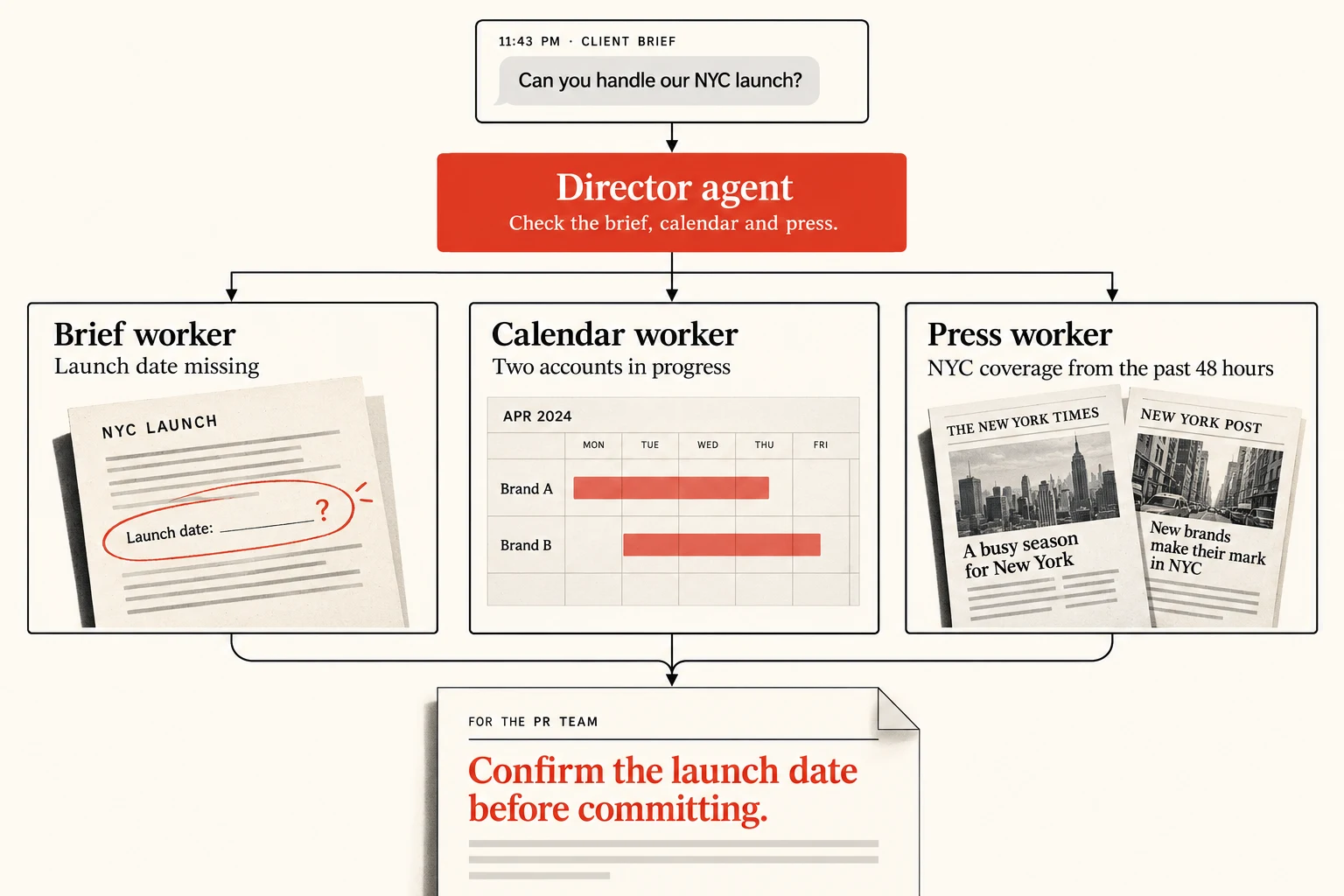
A new launch brief landed at 11:43 PM. A prospective clients wanted to know weather your PR agency could take on a massive New York launch and your team was already juggling 2 more accounts then they could handle. Before you can give them an answer, you need to know when the launch is, what they expect your team to deliver, and which details still need a follow-up.
Thats where AutomationsGoFar comes in. C.O.D.A.’s superpower starts at the top of the funnel where all the company information comes in. For PR agencies, many solutions intake specific information from the same handful of channels.
At AutomationsGoFar, C.O.D.A. customizes intake around the internal and external sources your PR agency actually relies on, from handling client calls that come in after hours or when staff are busy to tracking the niche publications your team monitors.
The backbone of C.O.D.A
At AutomationsGoFar, C.O.D.A is creating top funnel agentic orchistrations, that are specialized A2A teams with strict command hierachry in place. This allows the creation of a director agent that run's multiple worker agents to create ongoing monitoring for internal and external information sources that individual public relationship agencies monitor.
Each workflow is built entirely from scratch, allowing our team at AutomationsGoFar to create customized channel intake agents that are fully dynamic and communicate freely across channels, coordinating and reporting information 24/7.
C.O.D.A lead follow up
When creating C.O.D.A work flows for individual Pr agencies. Personalization is the number one thing that AutomationsGoFar team has in mind. If a lead calls, C.O.D.A. can be triggered to answer and gather the details your team needs. Information and follow up is passed through the channel that makes sense for the conversation.
C.O.D.A researched information composement and relevency.
When a new job information comes in for a PR firm, Omni dynamic worker agents are triggered to gather information for the propsed outline a client is requesting. Research is bounded by permameters such as:
- location relevancy - Bounded peramiters with in a set geographic area
- Platform relevancy - Bounded perameters agents must follow such as searching through LinkedIn for reccomendations given to a client.
- Timeframe relevancy - Bounded perameters agents must follow that corrispond with date related time frames.

For example, a New York City launch brief might ask C.O.D.A. to monitor 8 agency-selected sources for coverage affecting the 5 boroughs, and surface only items published in the past 48 hours
Once research is conducted information is sent to one uniformed point for further inspection. Seperate agents compare information by cross referencing client briefs from existing channels to the compiled information, making sure it alligns to the client needs.

If proposed information does not align, information is labeled as inaccurate and handed to an overseer agent. C.O.D.A workflows for PR agencies - each agent has one individual tracking id. This allows overseer agents to identify each agent and the work accurately. Depending on the serverity of inaccuricy in the worker agents research and judgement of relevent information. The overseerer agent will report directly to the director agent and if servere enough direcctly to our team at AutomationsGoFar.

How C.O.D.A handles gathering information for multiple jobs
Client packetsUnique IDsSeparate jobsClient packetsUnique IDsSeparate jobsClient packetsUnique IDsSeparate jobs
Client packetsUnique IDsSeparate jobsClient packetsUnique IDsSeparate jobsClient packetsUnique IDsSeparate jobs
Returning clientsNew requestsProject historyReturning clientsNew requestsProject historyReturning clientsNew requestsProject history
Returning clientsNew requestsProject historyReturning clientsNew requestsProject historyReturning clientsNew requestsProject history
Director agentsWorker agentsSource of truthDirector agentsWorker agentsSource of truthDirector agentsWorker agentsSource of truth
Director agentsWorker agentsSource of truthDirector agentsWorker agentsSource of truthDirector agentsWorker agentsSource of truth
01Assigning a packet
When a PR team has two or more jobs being juggled at the same time, C.O.D.A relies on created packet Ids. each client that an agency with is labeled with a unique id that can be refferenced to all agents within a C.O.D.A workflow to distinguish different jobs. Agents are tasked to direct all information into the unique packet and to research information only stored within the specific packet.
02Finding the right record
Each packet holds one clients information. Each packet has one unique Id and is stored in a companies source of truth. If a client is a repeating customer only the director agents within a C.O.D.A system can access the source of truth and pull the corrisponding packet Id to a client.
03Returning clients
* Note When a returning client brings a new request and not an add on to previous work, C.O.D.A. uses the previous project packet to understand the client, identify what’s different this time, and determine which details still apply.
04Keeping jobs separate
Within a C.O.D.A system, one of the main jobs that a director agent is responsible for, is making sure that worker agents are researching from the correct packet and not cross contaminating information. This is also through the help of overseer agen
If a launch brief comes in after hours without a date, who follows up?
Your agency decides who contacts the client. If your account manager handles follow-up, the handoff should flag the missing launch date and include the question to ask. If you authorize C.O.D.A to ask directly, you choose the channel and the details it can request. Research begins after the designated person approves the intake.
What does my team receive after C.O.D.A researches a brief?
The handoff depends on the brief. For a New York launch, it could be a proposed outline with the confirmed boroughs, relevant coverage from the past 48 hours, and a short list of open questions. Your account lead can see what is ready to use and what still needs a call with the client.
Can we trace a research finding back to its original source?
If your account leads need to verify every finding, make source references a requirement when we build the workflow. For a press mention, ask for the article link, publication date and passage supporting the finding. For a detail supplied by the client, the reference should point to the approved brief or call record.
Which inboxes, CRMs, call systems and media sources can we connect?
We scope connections around the tools your agency uses. Bring the names of your inbox provider, CRM, phone system and priority publications. We check what each one allows us to read or update and which permissions your team can grant before confirming the integration.
If a client emails a brief and then calls with a correction, how do the updates stay together?
The project packet is the reference point. If the caller confirms that the correction concerns the same launch, it belongs with that brief. If the client has two launches underway, the project name or date can settle which packet to update. A shared caller ID alone cannot distinguish those jobs.
Who can see an embargoed launch brief or approve access?
Your agency sets the access rules during setup. For an embargoed brief, identify the account lead who can approve access, the people allowed to receive a draft, and when wider sharing is permitted. The project packet keeps work organized. Access to its contents also depends on permissions in the systems you connect.
If two credible sources disagree, who decides what goes into the proposal?
Suppose the client brief says Friday and a trade publication says Thursday. The worker flags the mismatch for an overseer. Your account lead can then confirm the date with the client before approving it for the proposal. Keeping both references in the handoff shows exactly what needs a decision.